Pocket Park or Open Plaza for a Quick Game?
Pocket park or open plaza for a quick game? Match the surface, noise, room, and nearby activity to the play you have in mind.
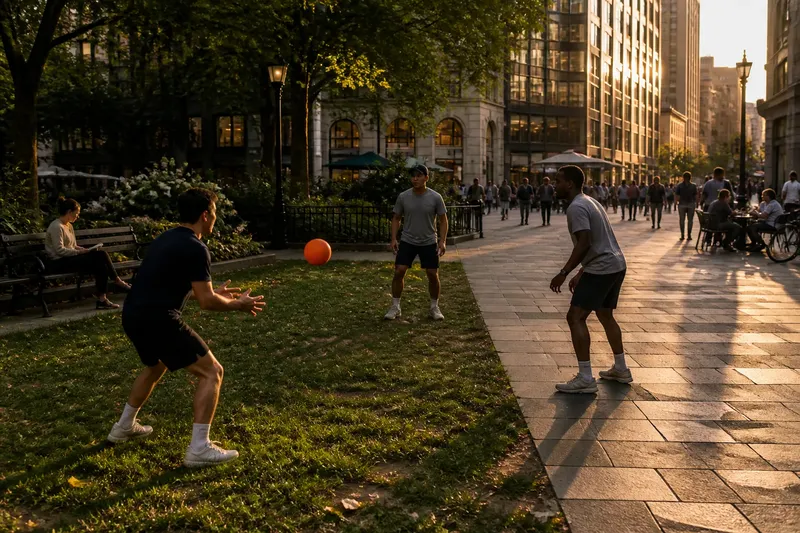
The common mistake in choosing a spot for a quick game is treating any open patch as empty space. A pocket park may be crowded by a path, roots, or a quiet-use expectation; an open plaza may echo every shout and send a ball toward passing feet. Picking the wrong setting costs the game its easy rhythm—and can turn a friendly gathering into friction with people who were using the space first.
Read the shape of the space before you unpack
A pocket park offers more than grass. Its edges—benches, planting beds, fences, and trees—can make a small game feel contained. A soft ball tossed between a few friends can suit that tucked-away character, especially if the play stays well clear of a path and anyone sitting nearby. But a narrow lawn can leave little room to retrieve a stray throw without crossing someone else’s route.
An open plaza usually gives a game clearer sightlines and firmer footing. You can see people approaching and adjust the play before bodies converge. That openness is useful, but it is not a blank court: paving joints, café tables, transit entrances, and the main walking line all shape where people can comfortably stop.
Make a slow pass around the edges before choosing a starting point. Look for the route people naturally take from one entrance to another, then leave it clear. Notice where children, dogs, food carts, and seated visitors tend to gather. A spot that looks vacant from one angle may be the place everyone uses to cut across the space.
Match the game to grass, paving, and sound
Surface changes the feel of play. Grass can soften a stumble and make a gentle toss pleasant, but uneven ground and hidden roots can make quick pivots awkward. Damp leaves can be slick, too. Paving gives more consistent footing for a low-key passing game, though a hard ball can bounce sharply, skid, or clatter in ways that are distracting to nearby people.
Sound belongs in the choice as much as the surface. A plaza between tall façades can throw voices and impacts back at the players. A small green space may absorb some of that noise, yet it can sit directly beside a quiet seating area. If the game involves repeated calls, a bouncing ball, or a lot of cheering, consider the nearest doors, benches, and occupied tables—not just the apparent distance to them.
Say you have a foam ball and three friends hoping to play catch after lunch. If the pocket park’s lawn is damp and a bench is occupied beside it, the plaza’s broad edge may be the better option, provided the group stays off the through-route and keeps throws low. If the plaza is crowded with people eating, a clear corner of the park may suit the same gentle game better. The choice follows the conditions, not the label on the map.
Choose a spot that lets others keep moving
Casual play works best when it looks easy to join and easy to pass by. In a plaza, leave a visible corridor between entrances and destinations; avoid setting bags or water bottles where someone might trip. In a pocket park, keep play away from the narrow path, planted beds, and the space directly around benches. A few feet of breathing room can matter more than a larger patch of ground.
Watch how people use the space for a moment. If pedestrians keep changing direction to get around your group, shift the game rather than asking them to weave through it. If someone is reading, eating, or caring for a child nearby, lower the energy or move to another corner. These are small adjustments, not a formal claim on the space.
- Check the surface for wet patches, loose gravel, uneven paving, or exposed roots.
- Keep entrances, curb cuts, paths, and the natural line between destinations open.
- Choose a ball and style of play that will not produce startling noise or unpredictable rebounds.
- Leave benches, planted areas, and occupied tables outside the play zone.
- Notice whether the space is already hosting another activity, and choose a different setting if it is.
- Pack out wrappers and move your belongings if the group changes location.
Use the setting’s edges without claiming them
Edges can help organize a casual game. A low wall may mark a convenient boundary for standing or waiting, and a tree can offer shade while the group takes a break. Neither becomes equipment just because it is nearby. Avoid throwing against walls, tying anything to branches, or treating planting beds as a backstop; those choices can disturb people and damage the place.
In a plaza, the edge might be a broad, empty stretch of paving well away from doors and seating. In a pocket park, it may be a patch of open lawn with a clear view of the path. Think of these features as cues for where play can fit, not as permission to convert furniture or landscaping into part of the game.
Local rules and posted signs can settle questions about ball play, noise, or reserved areas. Read them before starting, and follow any directions from staff or people responsible for the space. If neither site offers a comfortable, clearly available corner, a nearby designated recreation area is a better call than squeezing a game into a busy passage.
Which setting fits a quick game?
Is a pocket park better for a quiet game?
It can be, when there is a dry, open patch away from paths and occupied seating. The greenery may make a soft, contained game feel at home, but a cramped lawn or a quiet-use setting may make a plaza’s edge the more considerate choice.
Is a plaza suitable for a ball game?
A plaza can work for gentle passing if the surface is clear and the play zone does not overlap with pedestrian routes. Hard paving makes forceful throws and sharp rebounds less forgiving, so choose a softer ball and keep the game compact.
What should I do if the space becomes busy?
Pause, gather belongings, and watch whether the crowd is passing through or settling nearby. If the open area is no longer available without blocking someone, move to another suitable spot or end the game.
How do I choose between a pocket park and a plaza?
Start with the game’s movement, sound, and ball, then compare those needs with the surface, available room, and nearby activity. The best pocket park or open plaza for a quick game is the one where play can stay modest while everyone else uses the space comfortably.
A quick game should leave the place feeling as usable as it did before the first throw. Before you go, take one last look for a ball tucked by a bench or a bottle left at the edge; small cleanups make it easier for the next person to enjoy the same patch of city.