The Myth of the Perfectly Marked Playing Space
Faded court lines need not end a game. Use this week-long routine to read worn markings, agree on practical boundaries, and keep play easy to follow.

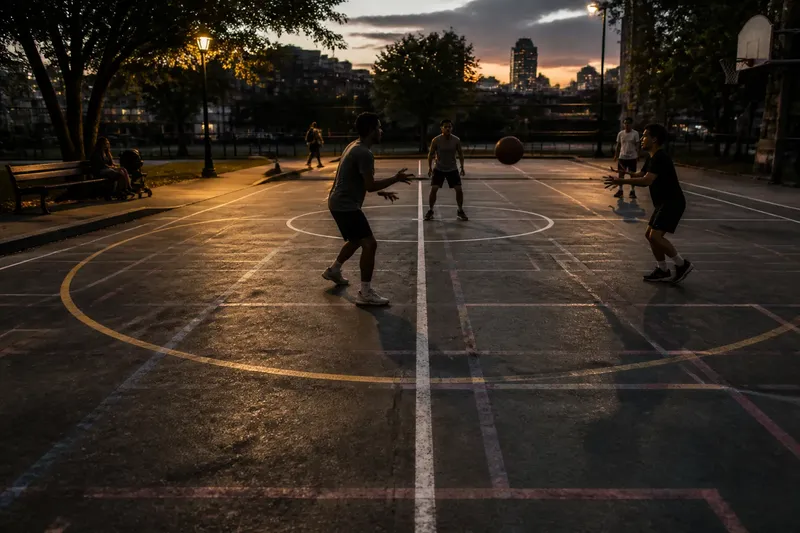
The most common mistake on a worn court is to treat every faded stripe as a failed instruction. That can cost a group its game before anyone touches the ball: players hesitate over a boundary, argue about a call, or leave a usable space. Faded court lines are clues, not a complete rulebook, and a short plan for reading them can make a return visit easier than starting from scratch.
Urban surfaces carry several visual languages at once. A scuffed arc may belong to basketball, a paving joint may divide materials rather than mark a court, and a pale rectangle may be an old layout. The task is not to reconstruct a vanished official design. It is to decide what the group can see, use, and revise together.
Read the ground as a changing visual surface
Paint wears unevenly. One stripe may remain clear while another breaks into flecks beneath grit. Rain darkens some patches; glare can wash out others. A mark that looks obvious from the entrance may disappear when viewed from the far side.
Notice the differences before deciding what they mean. A continuous stripe is easier to follow than scattered paint. A row of paving seams may be visible but uneven. A curb may define an edge clearly while also placing play too close to a walking route. A useful visual cue must be legible in motion and appropriate to the space.
Separate the evidence from the interpretation. “The pale stripe stops beside the drain” describes what players can see. “The line must have continued straight through” is a guess. Keeping that distinction clear prevents an imagined layout from becoming an unspoken rule.
Use a week of visits to make the agreement operational
A week-long routine turns observation into a practical decision without repainting, measuring, or claiming a permanent court. Treat each visit as a small check-in. If the same group cannot return every day, use the sequence across its next visits rather than forcing a calendar schedule.
- Visit one: map what is visible. Walk the playing area and note one continuous mark, one broken mark, and any path, bench, grate, or tree pit that should stay clear. If a feature is visible from both ends of the space, keep it on the candidate list; if it disappears or overlaps a pedestrian route, exclude it and consider a smaller area.
- Visit two: choose one anchor. Ask players to point to the same fixed feature, such as the edge of a painted pad or a paving joint. If everyone identifies it without debate, use it as a provisional boundary; if descriptions differ, drop it and look for a clearer fixed feature.
- Visit three: check the cue from play positions. View the anchor from each side where players will approach it, then walk its length. If it stays distinguishable and easy to follow, keep it; if shadows, wear, or an irregular course obscure it, shorten the playing area or choose another edge.
- Visit four: say the rule before play. State the boundary in one sentence, such as “The dark paving edge is out on the north side; the broken arc does not count.” If everyone can repeat the same interpretation, start with that rule; if not, simplify the boundary or agree on a neutral restart for uncertain calls.
- Visit five: track the disagreement, not every mark. During play, notice which specific edge causes confusion. If one edge produces repeated disputes, pause and revise that edge only; if calls remain clear, keep the agreement unchanged for the next visit.
- Visit six: test the revised reading. Begin with the updated wording and check whether players can make calls without stopping play. If the rule is easy to apply from both sides, retain it; if one position still makes the cue hard to judge, reduce the playing area or use a neutral restart.
- Visit seven: decide what carries forward. Review the anchor, the rule, and any recurring uncertainty. If the cue remained visible and the agreement stayed fair, reuse it as a working arrangement; if conditions or viewpoints made it unreliable, discard it and begin the next session with a different cue.
These are not seven days of waiting for a court to reveal its original design. They are seven concrete opportunities to make a shared reading more usable. The group can stop early if a cue works, or change direction as soon as the space proves unsuitable.
Say you are returning to an invented schoolyard pad with one intact white stripe, a broken arc, and a straight seam between asphalt and paving. On the first visit, the group notes that a bench and a walkway make the far edge unsuitable. On the second, everyone points to the seam as the clearest opposite boundary; on the third, players walk it from both ends and see that it remains distinct. They agree, “The white stripe and the paving seam are the sides; the broken arc does not count.” During play, a ball crosses the seam and the call is clear. If a later visit puts deep shadow across that seam and players cannot follow it, the expected decision is to shrink the area or choose a different edge, not to insist that the old rule still fits.
Choose cues that remain clear during play
Test a candidate boundary from the positions players actually occupy, not only while standing in the middle. Look for a fixed feature that is easy to describe and follow. Distinct paving materials, a continuous curb, or a surviving stripe can work; none is automatically suitable just because it looks straight.
Temporary objects can create a new boundary, but they can also move, trip someone, or obstruct a route. Do not chalk or otherwise alter public surfaces unless the space allows it. Keep any permitted marker out of walking paths, and remove it afterward. If the group cannot define a safe, legible playing area with available cues, choose a different game or place.
Keep the game boundary separate from the safety boundary. A group may agree that a curb is “out,” but that ruling does not make a nearby street, cycle lane, or crowded walkway safe for a sprint or a loose ball. Leave room for people passing through, respect accessible routes, and stop if play cannot be kept clear of hazards.
When should a group change its reading of faded court lines?
Should every surviving stripe count as a boundary?
No. A stripe may belong to another sport or an earlier layout. Use it only if it fits the game, is easy to identify, and does not direct play into an unsafe area.
What should players do when a line disappears?
Do not argue about where the paint might have continued. Choose a nearby fixed cue, make the playable area smaller, or use a neutral restart for uncertain calls.
Can a paving seam work in place of court paint?
Yes, if the seam is visible and simple to follow from the relevant positions. Treat it as the group’s approximate reference, not as an official or exact marking.
When is the space too confusing to use?
If players cannot agree on a legible boundary or play would overlap with traffic, pedestrians, or another hazard, change the format or move. A clear arrangement matters more than preserving a particular court shape.
Let the game ask only for the boundaries it needs
Different games need different visual information. A casual basketball game may need a clear out-of-bounds edge, while a passing game may need only enough room to stay out of people’s way. A small-sided soccer game may need recognizable ends and a restart point, but not every remnant of an old painted layout.
Resist the urge to assign meaning to each mark. If a faded arc has no bearing on the group’s decisions, leave it alone. A compact area anchored by a couple of clear edges may be easier to read than a larger space whose corners depend on guesswork.
Fairness matters as much as visibility. A cue that only the player nearest it can see may give that player too much influence over close calls. Before play, agree on what happens when the evidence is unclear: replay the point, treat the ball as still in play, or use another simple neutral rule. If the same disagreement keeps returning, revise the boundary rather than letting the loudest voice decide.
Keep the agreement ready to change
Light, weather, crowds, and the group’s position can change how the ground reads. A boundary that worked on a bright afternoon may vanish in shadow. Check what has changed before each session, and revisit only the cue affected by it.
Faded court lines can help a group orient itself, but they do not have to dictate the game. A clear, limited agreement lets players use the visual language that remains while leaving room to adjust when the surface, the game, or the people using the space call for a different reading.