The Basketball Hoop Above the Garage and the Improvised Gear That Keeps City Games Moving
See how the basketball hoop above the garage and other improvised gear turn ordinary city objects into invitations to play, with practical context for each.
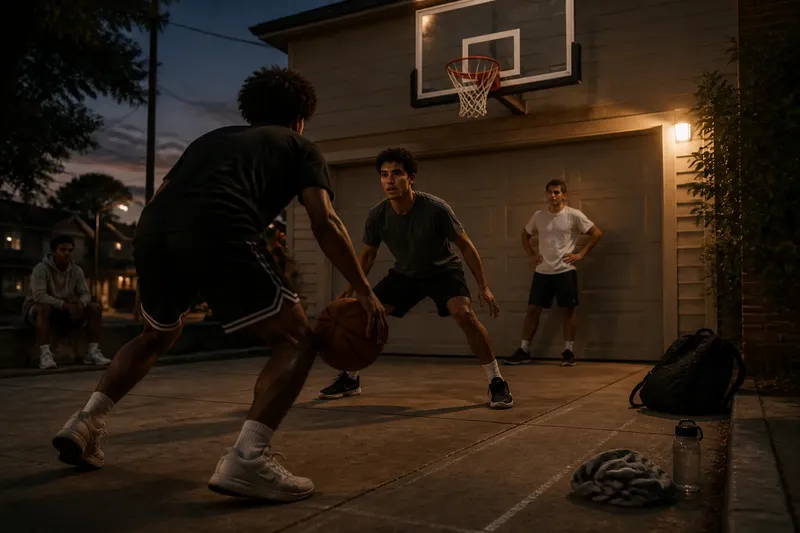
The common mistake is to think a neighborhood game begins with proper equipment; that assumption can leave a ball sitting in a bag while everyone waits for a court. A basketball hoop above the garage tells a different story: the game can start when a useful object, a bit of space, and a few willing players meet.
Improvised sporting gear is not merely a budget substitute for official equipment. It is a record of how people adapt play to the city they have: a door, wall, curb, chalk mark, or sturdy container can supply a target or boundary. These objects shape the game, too. Here are five ways ordinary things have helped make informal sport possible.
1. A garage hoop turns a household edge into a meeting point
The garage-mounted hoop is an especially legible example because it borrows a familiar piece of domestic architecture and gives it a public-facing purpose. A driveway becomes a place to shoot, practice a layup, or call a quick game. The hoop can be visible from the sidewalk, making play easy to notice and easy to join without requiring a formal invitation.
Its makeshift character lies less in the hoop itself than in the arrangement around it. A chalk line may stand in for a free-throw mark; a seam in the pavement can become a boundary; a mailbox or parked car may make the usable court oddly shaped. Players negotiate those conditions as part of the game. A driveway with limited room might favor close shots and quick turns, while a wider apron invites longer attempts.
That flexibility has limits. A garage hoop does not make a driveway a court, and active traffic, fragile property, or an obstructed walkway can make play unsuitable. The owner’s permission and the comfort of neighbors matter as much as the hardware. Where a hoop is fixed to a building, follow its maker’s directions and applicable local requirements.
Say a group of neighbors has a hoop over a driveway but no painted lines. They agree that the edge of the concrete is out and that each player takes a shot from the same visible paving joint. The expected result is a game everyone can understand without needing to mark the surface or argue over an invisible boundary.
2. A wall can serve as both partner and opponent
In a crowded neighborhood, a flat wall offers something an empty field cannot: a dependable surface for a game with one player or a small group. A tennis ball rebounding from a blank wall can support handball, wallball, or personal drills. A player supplies the missing opponent by choosing where and how the ball comes back into play.
The surface changes the rhythm. Brick may produce a different bounce from smooth concrete, and a slight slope can send a return veering off course. Players learn these quirks through repetition and adapt their rules accordingly. A wall that returns the ball sharply may reward quick reactions; a softer surface may keep a rally going longer. The wall is not just a backdrop. It is an active piece of sporting equipment.
Urban walls also carry other uses and obligations. A school building, storefront, or apartment façade is not automatically available because it is flat. Ask permission where needed, avoid windows and doorways, and choose a place where stray balls will not put pedestrians in the path of play. A handball alley or recreation-center wall, when available, makes the arrangement clearer and more welcoming.
3. Curbs and seams create boundaries without building a field
Street games often need a way to decide what counts as in. A curb, sidewalk seam, drain cover, or change in paving can become a boundary that players can see and remember. The city supplies a rough diagram, and players decide how to read it.
These boundaries make a game portable. A small patch of pavement can host a kicking game, a throwing challenge, or a pared-down version of a larger sport. The rules may be adjusted to fit: a curb can count as a goal, or a seam can divide two sides. The particular object matters less than the shared agreement that gives it meaning.
That agreement should be made before play begins. If one player treats a curb as a goal line and another thinks it is out of bounds, the object has not clarified the game; it has merely moved the disagreement. Keep the boundary away from ramps, crossings, and busy entrances, and leave a clear path for people who are not playing.
4. Chalk and tape make temporary equipment visible
Chalk can turn an indistinct patch of ground into a play space without leaving a permanent mark. A quick circle might define a target; a few short strokes can show a service area or a starting spot. Painter’s tape can help indoors or on a suitable smooth surface, though it may not adhere or come away cleanly on every material.
Temporary marks have a useful social quality: they show newcomers what the players have agreed to. A line on the ground is easier to interpret than a rule passed around by word of mouth. It can also be changed when a game grows, shrinks, or needs to leave room for someone passing through.
Use marks sparingly and choose materials suited to the surface. Chalk may wash away but can still be unwelcome on some buildings or paving; tape can leave residue or create a trip hazard if it lifts. Ask before marking private property, and remove temporary materials when the game is over. A visible boundary should make play easier to share, not harder to use the space afterward.
5. A bag, bottle, or spare garment can settle a game’s small needs
Informal play often depends on objects that solve minor problems rather than replace a major piece of equipment. A backpack can mark one side of a goal; a rolled-up sweatshirt can show where a player should stand; a reusable bottle can identify a team’s corner. These objects are easy to recognize and quick to move when the game changes.
They also carry a practical warning: not every ordinary object is a good marker. A glass bottle can break, a bag can hide belongings, and a loose item can become a tripping obstacle. A soft, visible object placed outside the main route through the space is generally easier to use responsibly. Players should keep valuables elsewhere and make sure the marker does not obstruct a walkway or access point.
Imagine two friends want to play a short soccer game in a quiet, open plaza but have no cones. They place two soft caps beyond the playing area to suggest a goal, then move them farther apart when a passerby needs extra room. The expected result is a target that remains easy to see while the shared space stays usable for others.
Why do improvised sports objects matter?
What counts as improvised sporting equipment?
It is an ordinary object or feature used to support a game rather than equipment made specifically for that sport. A wall, curb, chalk mark, or soft bag can define a target, boundary, or place to stand.
Does makeshift equipment change the rules?
Often, because the available object shapes what players can do. A narrow driveway may favor close-range basketball, while a wall can turn a solo practice into a rebound game; players adjust the rules to match the space.
How can a group make informal play easier to join?
Choose visible markers, explain the basic boundary before the first turn, and leave room for people passing through. A newcomer should be able to tell where play happens and how to take part without guessing.
When should players use proper sports equipment instead?
Use purpose-made gear when an improvised object is unstable, sharp, breakable, or likely to damage a surface. If the activity or location raises a safety concern, choose an appropriate facility and ask a qualified professional when needed.
Improvised gear is part of a city’s sporting language
A garage hoop, an echoing wall, and a chalk mark may look like separate solutions, but each makes an invitation legible. The object says where to aim, where a boundary lies, or how a game can begin. Its meaning comes from the players who agree to use it, and from the neighbors who share the surrounding space.
The basketball hoop above the garage remains memorable because it makes that negotiation visible: domestic space reaches toward the street, and a piece of equipment gives a passing glance somewhere to land. When choosing an improvised object, look for something clear, stable, easy to move, and compatible with the space around it. That small judgment can help a game begin without making the city harder for anyone else to use.